The Making of “This and This”

Five years ago, during the pandemic lockdown and all the chaos of that summer, I remember struggling to find words for a sense that kept echoing through my body. 

It was something like this: A pivotal point in history has arrived, and I am not ready for it. Or maybe this; A pivotal moment in history has arrived, and my self has not been formed to respond. Or even: A pivotal moment in history has arrived, and I only know two responses: anger/despair, or distraction/distance. 

Maybe you can relate, maybe you can’t. But five years later I feel even more certain that the self we form in the daily acts of our lives becomes critical and clear when a season of crisis comes. Is our sense of psychological wellbeing grounded in the conviction that all will continue on as normal, or is there space for uncertainty and grief? Do we try to soothe our anxiety with words like, “Don’t worry, that won’t happen” or are we able to live with, “Yes, that could happen and yet…” 

If I look back over my writing in the past five or six years, I see many themes emerge. One of the clearest is this search for God within the brokenness and wreckage, a belief that beauty and sorrow often walk hand in hand. I can see that I have been trying to practice the tension of accepting all possibilities, and still finding peace. To not remove myself from the sorrows of the world, but to be unshakable in the midst of them. To find a peace, in other words, that is not a withdrawal from painful realities but a looking through them. To find God there; to face the worst and be unafraid. “What can man do to me?” the Psalmist asks. In truth, he can do much – but as the martyrs and many other holy people remind us, no man can truly harm someone whose Self is secure in God.

“God is there at the point of greatest tension, at the breaking point, at the centre of the storm. In a way despair is at the centre of things — if only we are prepared to go through it,” writes Metropolitan Anthony Bloom. 

“As Christians we are always in tension —in anguish and at the same time in bliss. This is mad, ridiculous. But it is true — accepting the dark night just as we accept the brilliance of the day. We have to make an act of surrender — if I am in Christ, there are moments when I must share in the garden of Gethsemane. There is a way of being defeated, even in our faith — and this is a way of sharing the anguish of the Lord. I don’t believe that we should ever say, ‘This cannot happen to you.’ If we are Christians we should go through this life, accepting life and the world, not trying to create a falsified world.” (Beginning to Pray)

Last September, I was at the tail end of a difficult year, and many others around me were walking through layers of grief. All the terrible things people feared were indeed happening to them. And yet – the apples were ripening, the roses were magnificent, and the end point of all of this was the Resurrection of the world. 

And so I wrote this poem. I hope, at least, it is the continuation of an attempt to accept “the dark night just as we accept the brilliance of the day.” And I hope it reminds us all, even as terrible things keep happening and happening, that instead of skirting around the edges of despair, we must be prepared to go through – and find Christ there deep in the heart of it, burying the seeds of resurrection roses. 

May we learn to be people who are wise and unafraid. 

Jenna
“Invisible” Women

It was my great joy to partner with We Choose Welcome to share this poem, “Invisible” Women. 

From the notes: “’Invisible” Women’ gives language to the quiet strength of women the world tries not to see. Women whose hands prepare meals, whose voices hum songs of survival, whose courage endures even when sorrow is ignored.

These women are not invisible. They are wisdom-keepers, truth-tellers, and bearers of dignity in places where injustice seeks to diminish them.”

Read the poem on their website, here.

A Reading of “Like the Light, She Arrives”

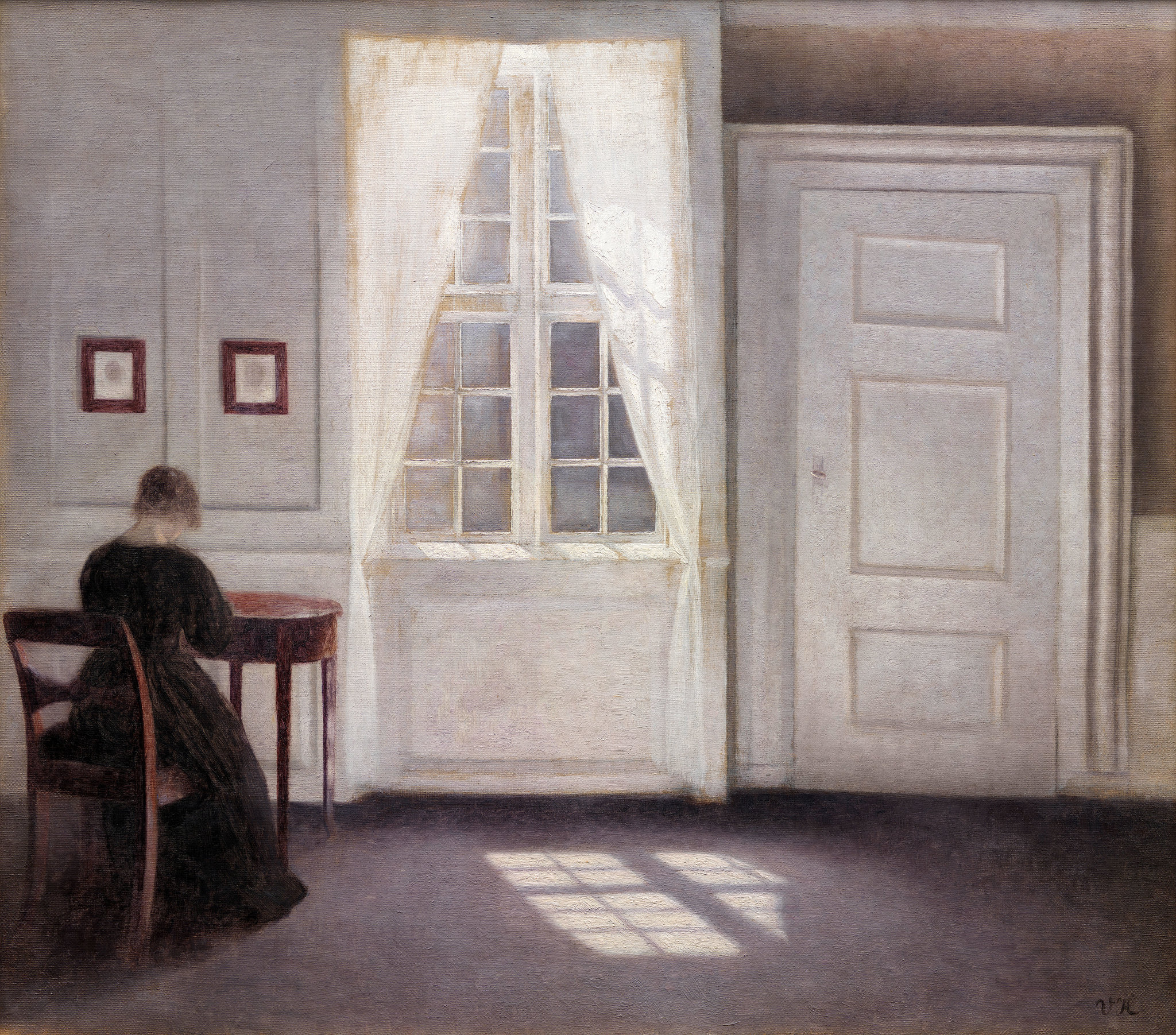
In continuing with this small celebration of Bright Inhabited Lives‘ one-year anniversary, I’m reading an excerpt from another prominent series of poems in the book, based on the artwork of Vilhelm Hammershøi.

This poem is a connected series of seven haibun poems, all exploring themes of Vilhelm Hammershøi’s interior works. Take a listen here:

You can view some of Hammershøi’s quiet, sometimes haunting interiors and learn more about his work as an artist here.

Learn more about the book here.

This poem was originally published in its entirety by The Ekphrastic Review.

New Book: Bright, Inhabited Lives

“Incidental to the evidence 

   That meaning proves

Like a dough,

That thoughts do reach out

             From the page

And claim us, knead

             Us into form, rise

 – An experience of the word

So bodily, eyes 

             In the meeting 

Of print and finger,

             Each word

A journey your hand

Must travel, send postage…”

Hello dear friends. I am thrilled to announce that after months of waiting, my next book titled “Bright, Inhabited Lives” is now out in the world! Find it on Amazon, or on the publisher’s website here

As I encountered these poems again on the physical page, I couldn’t help but think again of these lines above, which you’ll find tucked within the pages of this book. I hope these words take you on your own journey into deeper layers of meaning, possibility, and our rich human capacity for life. 

If you do pick up a copy this week (which I hope you do), it would make my year to see some reviews or comments come in, and hear how these words continue to live on in the world!

Together in the mystery,

Jenna

A Poem for the Turning of a Year

How I wander through these 

days, stranger to my own making;

treading on thin spaces, and 

the cracks expand across 

the distance to where You live.

A wind blows and it whispers

Only words of you. A crow 

settles in the trees Outside 

the window and calls

Your name.

You call us, and we hunger. 

You fill us, yet we cannot 

get enough of You.

You, there beside us 

in our kneeling prayer,

claiming us and yet ascending

in Your loving higher

until we are compelled 

to bow 

and love You so our hearts 

may burst 

while knowing we are Yours

and shall be in Your life

and life is Real and sharp

among our ribs.

I watched the crow for days

before I caught the secret

of your love affair

before I saw he only glanced

towards where You stood

rejoicing in his ebony creation.

And I knew my heart 

would burn again

towards You

I knew that I would 

wander, and return

again, 

              would

offer up this world

again 

            and over again

and always it would be

to You.

You will be the song I hum

in the dark, forgetting

Who it is I sing of

You will be the One 

watching, giving 

planting, birthing

                                always

a lopsided love affair

delighting in the 

slow ripening

of my resurrection

calling my name

in the wind 

and the wilding sky.

I began this poem on my 30th birthday this year, and finished it while in Assisi several months later. Since then I’ve returned to it often as a touchstone, a reorientation point, and I felt it would be appropriate to share now as we pass ”the still point of the turning world” (T.S. Eliot) and head into a new year.

May it be a year of journeys, and a year of returnings. May it be a year your soul ripens and expands into new and beautiful wings.

Happy New Year, friends.

Leftover Miracles

Calais, France

My mouth is narrow.

I cannot open it wide enough

to feast on all that a day offers.

Example: today

the sky is a sinkhole

writing in watercolor

which the crows are circling

(those slicked, stern critics)

there are eleven new roses

swathed around sticks

like tufts of pink cotton

almost too sweet

and a man stops

to tug a bit

on his daughters jacket

and answer why

for the seventh time 

he nearly misses

the shuffling bus

on which everyone notices

each other

and pretends not to

on which two women 

will tell him, what a sweet

child, and he will glance

at another man’s newspaper

surreptitiously.

Onion skins waft

their way into everything

a promise of tomorrow’s 

bounty, and the handprints

climbing up the walls

like a prayer.

And one mother holds

a sick child close 

to her breast, incarnate

Madonna of the one

resting in the corner.

Anything 

could be

ahead –

tiny fingers 

iridescent with suds

wild mornings

that suddenly grow still

the steel blade of hope

knifing its way through

a kind of despair

it is too much

to chew;

I am gulping 

the world down whole

I am managing

only the crumbs 

the leftover miracles

piled into baskets 

(nothing is wasted

after all, keep the

big meals for the ones

with larger stomachs)

I am watching the world 

break open and multiply 

before my very eyes.

Easter Poem

Through the arched colonnade

Of brick and glass

The sky draped, a cotton sheet

Of Easter blue

Forgotten on some larger being’s

Laundry line

Shuddering in the silent breeze.

The light ran down the glass

In golden waterfalls

Pooled into a thick, caustic shadow

Beneath the greying elms

Hunched into their years 

Of watchkeeping

And whispering to their knees.

And where were you, reader,

When the first fingers of their minds

Crept up out of the wound of earth

And drank it in?

Continue reading