I hope you enjoy my new poem, Pilgrims I Have Been. I’m curious – do you ever feel the tension between growth and contentment?
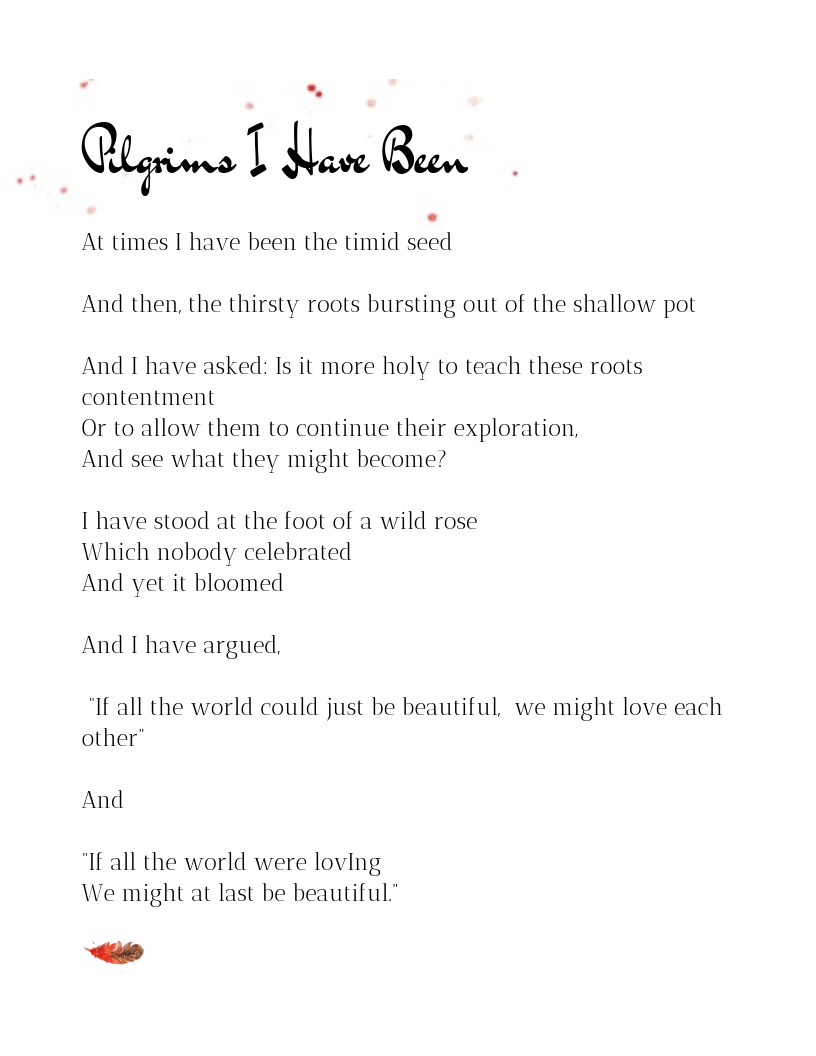
I hope you enjoy my new poem, Pilgrims I Have Been. I’m curious – do you ever feel the tension between growth and contentment?
I’ve been covertly writing poetry all my life, but lately it has become an important spiritual practice for me. I call it the Practice of Paying Attention. Not only has this practice been incredibly healing, but it’s awakening a part of myself I’ve always been a bit reluctant to share with the world – the part of me that delights in beauty and mystery.
The poet Paul Murray speaks of the moment as “the place of pilgrimage to which I am a pilgrim.” When I think about how I want to live my life, the word that always comes to mind is as a pilgrim, in the most ancient sense of the word.

To live as a pilgrim is to live simply, purposefully, and expectantly. To have a clear destination in mind, but to take what comes day by day. It is cultivating the art of paying attention to the fullness of the life around us.
Every moment is transparent with possibility. Each person we meet is a fellow-traveler with a story to tell. The question is: Can we remain open to being changed?
The more I’ve thought about what I wanted this 28th year of my life to be about, the more I keep coming back to this. And so, I’m taking a deep breath and “going scared” and inviting you to journey along with me. I’m calling it the Pilgrimage Poetry Project. For the next year I’ll be writing poetry following the ancient Church calendar and seeking to find God in the moments of every day. Afterwards, I plan to publish a small collection of poetry and art (eek!). It would be a delight to have you journey with me on Instagram, Facebook, and right here.
 Originally I thought I should wait and begin the project at Advent, the official beginning of the Church calendar. But then I thought – if this is all about finding God in the ordinary, then what better time to begin than Ordinary Time?
In that vein, I’d like to begin by sharing my first poem with you. My hope and prayer is that this project will help us all to practice the art of paying attention to our lives and find God present there.

A heart deadened to its own struggles can never be a refuge for the struggles of others.
– Shannon Evans
I hate my weakness.
Well, let me put it this way. Some human weaknesses – like mild fear, shyness, or the tendency to forget small details – may seem endearing. I don’t mind embracing the parts of me that are moving towards wholeness, even if slowly, or things that are just part of the way I was created. Some weaknesses I can live with.
But other flaws I really do hate. These are the parts of me that hurt other people, that can feel crippling, that make me wonder if I’ll ever slay the dragons that have become my demons. These are the places where I understand why people self-harm. To come face to face with your own deep brokenness can be a terrifying and even enraging experience. “Embrace” is the exact opposite of how we want to react.
And yet, if we do not learn how to engage these dark places of our hearts, we cut ourselves off from the fullness of connection, empathy, and healing we could experience.
Some of us have experience crippling weakness from our own bodies as well as our hearts. Some of us have had great wrongs done to us. It can feel as if life itself betrayed us, because we know this is not how it should be. And yet.

“The power of the gospel is not that we no longer suffer or struggle, but that we no longer do so alone.” (Embracing Weakness)
While our pain and struggle is not what God intended on this earth, it can still yet be an invitation. In what seems like a dark hole, there can be a doorway. We are invited to allow our weakness to create new places of empathy and love in our hearts. We are given the opportunity to find new solidarity with the poor and the suffering in our midst. We learn that they have much to teach us, and we learn to listen.
How often we try to run from our greatest invitations.
Recently I discovered this writing that I had jotted down during Lent:
Being human is to inhabit mystery, to live in weakness.
And in that weakness there is a beautiful dependence we often run from.
Because weakness is also painful – we cannot glamorize weakness, deprivation, dependence, despair.
We cannot gloss over the pain of God’s confounding silence,
the grief and confusion of loss,
the disappointment of withered hopes.
Weakness can be ugly, inconvenient.
Mystery is never comfortable.
But deep within, there is a voice:
Be obscured
Be prepared through the confounding silence of God.
A conversation on the church, with Ben Myers’ book The Apostles Creed.
It is astonishing that for a movement that utterly changed the world, Christianity has such humble origins. As Myers writes:
Jesus wrote no books…He was the author not of ideas but of a way of life. Everything Jesus believed to be important was entrusted to his small circle of followers. What he handed on to them was simply life. He showed them his own unique way of being alive – his unique way of living, loving, feasting, forgiving, teaching, and dying – and he invited them to live the same way.
The more I get a taste of the global church, the greater the mystery it is to me. How can it be that when I’m in a remote village of Tanzania, or a small town in Sweden, I can feel so at home in a church so outside of my culture and context? How is it that we embrace or shake hands with each other in genuine love as brothers and sisters in the Gospel? The faithful existence of the global church, in all its unity and disunity, is a miracle. Continue reading
How can I explain what the last few weeks have been like?
In the month of February I had the privilege to meet local leaders who have become my heroes. I have been reminded of what it means to welcome and be welcomed; to value honor and hospitality; to life a life of service in ways both big and small. They humble me and teach me and inspire me.
Note: I wrote this letter to myself in much earlier days of this blog, but never published it. I just came across it again today and felt it was time to share it with the world. Although it emerged in the midst of much personal wrestling and prayer, I hope it strikes a chord of resonance with you as well.
Dear you –
The one who is tired,
the one who sits there staring out the bus window,
wondering if she’s the one who has it all wrong.
The one who recognizes in herself the same criticism
the same jumping to conclusions
the same line-in-the-sand mentality
that frustrates her in others
and wonders how we ever heal from it all. Continue reading
As the evenings get darker and the calendar flips to December, I’ve been thinking about the past year and all it has held for us. What words do I want to end the year with? What words do I want to hold on to into the new year?
This has been a year of many new beginnings and some endings, many moments of joy and some of grief, and in the midst of all of it, grace. Sometimes grace found me like a splash of cold water across the face, but sometimes in was the small shadow creeping up from behind, surprising me softly. Mostly I have found it in the quiet, glad moments that are hard to describe in any other way than a deep welling up of gratefulness.
What has been most surprising about this year is the way it has been exactly and yet nothing at all like I expected. I saw this as a year of growth and it has certainly been so. Yet the word I chose for this year was “beauty,” and this beauty has turned out to mostly come from places I wasn’t even looking for it. Continue reading
I’ve never thought of myself as a powerful person. Or even a person who is tempted by power. Perhaps this is because I’ve never seen myself as much of a leader — I’d much rather be the support squad .
But what is power? Often we equate power with leadership or authority — a big presence, someone who can call the shots. But at its core, power is simply the capacity to affect reality. Who doesn’t want that? Continue reading
For as long as I can remember, I’ve wished to be part of a culture rich with tradition and weekly rituals like the Sabbath prayers or traditional dances. I was hungry for a way of living that felt more embodied and yet transcendent.
More than this, I craved holy words. When I looked out across the Alps, listened to a hurting friend, or walked in my neighborhood in the glory of a spring day, I longed for a prayer to rise to my lips that fit a moment like this.
I was looking for a liturgy. Continue reading
Recently I’ve been considering what it means that we are not only beings that think, but desire. It seemed appropriate during this season of Lent to meditate on what it means to hunger, in the deepest sense of the word. And now, on Maundy Thursday, I think it is only appropriate for us to meditate on Christ’s final meal with his disciples–the Eucharist, and what it reveals about the point of all our hunger.
Alexander Schmemann notes, “In the biblical story of creation man is presented first of all, as a hungry being…and this image of the banquet remains throughout the whole Bible, the central image of life.” Continue reading
 Downwind of Grace